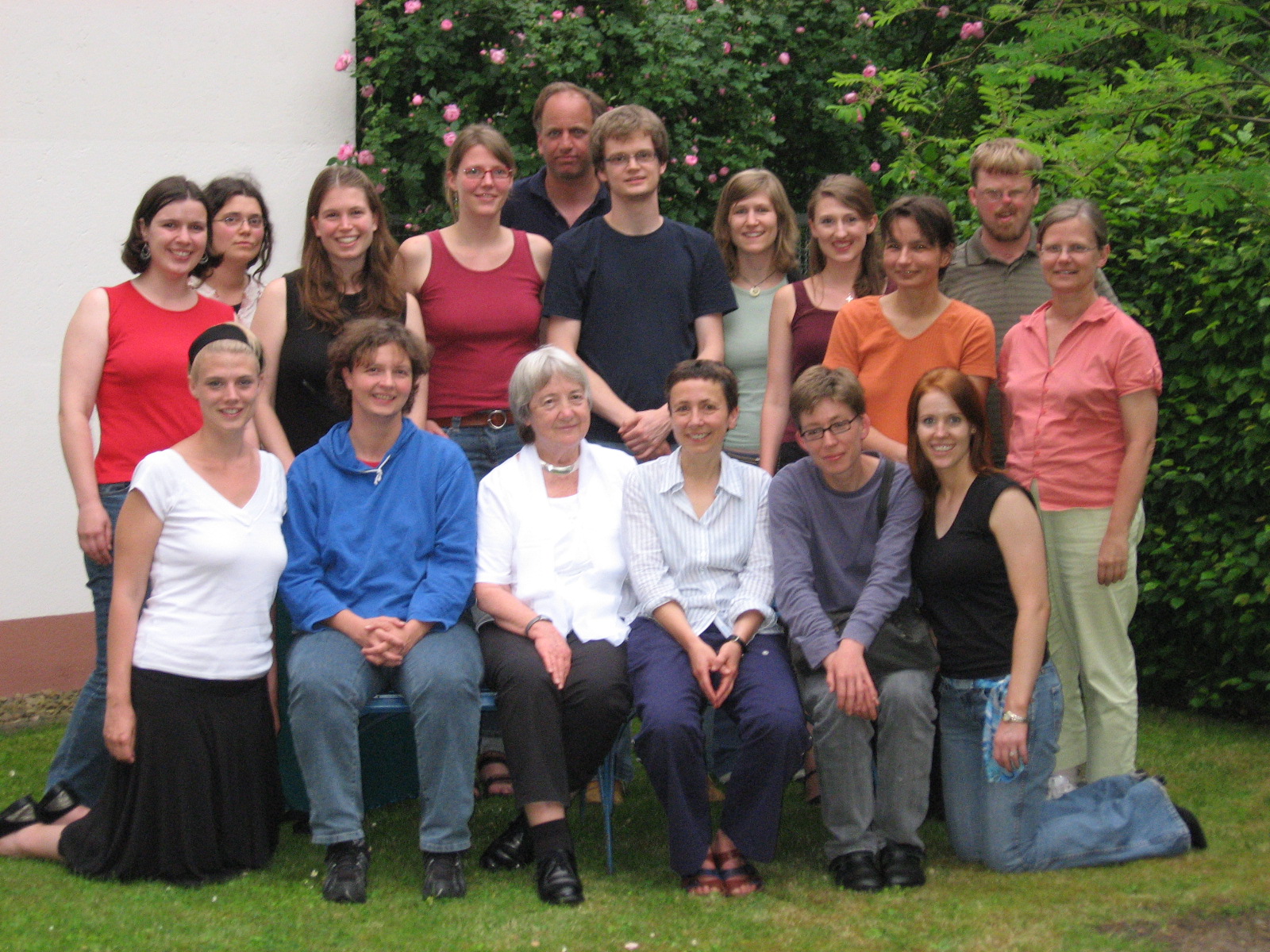
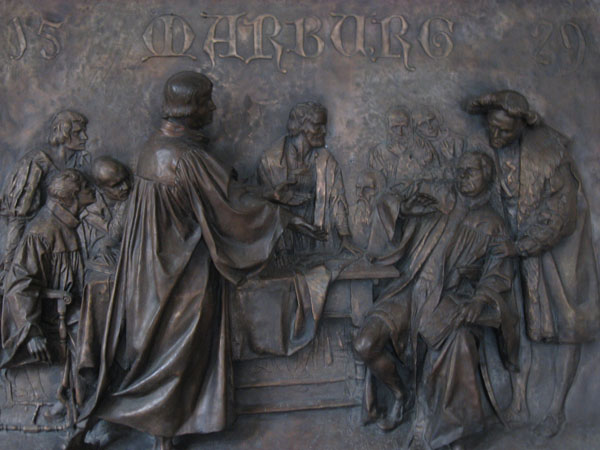
From June 1, 2006 through June 22, 2006, students from Union Theological Seminary in the City of New York traveled to Germany to study Paul's Letter to the Romans with students from Marburg University. Taught by Professor Luise Schottroff, this course proved to be an amazing experience. Our German hosts opened their doors and lives to us. We were welcomed into our host families' homes and transformed into soccer fans. Our class transcended the walls, and our classmates became true friends. Romans will never be read the same way and Germany will stay in our hearts.
Theological- Exegetical- Spiritual Dictionary of Key Terms in the Letter to the Romans
Written by Union Theological Seminary and Marburg Students:
Karen Byrne, Ashok Chaudhari, Erin Fleming, Paul Grenier, Nora Harmann, Hannah Hofheinz, Elisabeth Kruse, Kerstin Menzel, Sabine Neufeld, Sarah von Oettingen, Ruth Poser, Renja Rentz, Evelyn Talmon, Christopher Williamson
hamartia/sin
Romans 3:9.20; 4:7.8; 5:12.12.13.13.20.21; 6:1.2.6.6.7.10.11.12.14.16.17.18.20.22.23; 7:5.7.7.8.8.9.11.13.13.13.14.17.20.23.25; 8:2.3.3.3.10; 11:27; 14:23 (48 matches)
Paul most often uses this word in the singular describing a demonic power, an imperial ruler (3:9; 5:21; 7:17.20). The word does not refer to moral individual actions but to the structure of injustice that leads to physical, psychological, and social death (5:12; 6:12-14; 8:10). This structure of sin affects all creation in a communal sense. Sin alienates people from the Torah and from God's will (7:7-25); sin misuses and occupies Torah, causing people to be unable to realize God's life-giving justice and charity - instead, sin takes them as slaves. For Paul and his communities, this is a reason of mourning in solidarity, thereby actualizing First Testament words (3:9-18).
Sin becomes manifest in the Roman's empire idolatry and cultic actions, whereby the uniqueness of Israels's God (Deut 6:4-5) is deeply questioned and afflicted (1:18-25).
Revelation of God's rightousness in Christ (1:16-17) and of God's wrath (1:18) must be seen together, the former making individuals aware of the latter (ch. 8 and 7). In raising Christ from the dead, God liberates us, first of all, to open the eyes, to realize the structures of sin and death and our own involvement, our complicity in them. It is the pouring out of God's empowering Spirit that "now" (3:21) breaks down the power of sin, sets free God's life-giving will, leads to prophetic analysis of the present destruction of creation, and enables to resist it with passion and sympathy (8:25).
anastasis nekron/Resurrection of the Dead:
Romans 4:19; 6:1-11; 8:11
Continuing in the tradition of Jewish teachings, Paul connects the toledot of Israel with Christ's resurrection and calls upon Israel's patriarch and matriarch, Abraham and Sarah, to introduce the concept of resurrection from the dead (4:19). Paul describes the bodies of Abraham and Sarah as dead because they are old. Through relationship with God, their bodies are resurrected and give life to the people of Israel. Paul continues to elaborate on the idea of resurrection through exploration of Christ's resurrection showing it to be death to sin and an eschatological new life in the present. Rather than a dualistic understanding of temporal life after death and body and spirit, we are shown to be resurrected by God from the structural sin that is death in Paul's words to find life in relationship with God (6:1-11; 8:11).
dikaoisyne theou/justice of God
Romans 1:17; 3:5.21.22.25.26; 4:3.5.6.9.11.13.22; 5:17.21; 6:13.16.18.19.20; 9:30.30.30.31.31; 10:3.3.3.4.4.6; 14:17 (34 matches [sometimes without explicit reference to God])
The term dikaoisyne is a forensic term refering to God as a judge, but including a counter image to human judges who are often experienced as corrupt. God's justice can be understood in the sense of a Genetivus Subjectivus or Genitivus Objectivus, which refers to God's qualities or to God's gift of justice. In the Pauline letters it seems to include both aspects (Rom 1:17: "For in it the righteousness of God is revealed through faith for faith; as it is written, 'He who through faith is righteous shall live'"; compare also 3:26; Phil 3:9).
Justice is revealed in the moment of experiences of resurrection throughout history. For Paul, the resurrection of Christ is the crucial experience of resurrection for the world and from this experience Paul reflects on other resurrections, e.g. Abraham and Sarah (Rom 4).
Resurrection makes clear that justice can already be experienced in history, but at the same time it has an eschatological aspect in the sense that justice will be revealed to all creation. God's justice takes place in God's future, i.e. in God's nearness, which already determines the presence for Jews and Gentiles.
In the Messiah, God's justice begins to speak (10:5-8), a way by which it moves people immediately and deeply (compare e.g. Jer 31:31-34). At the same time, that means that "speaking justice" can be heard by all people, that it achieves all ears, and by this way is opened for gentiles as well.
Sometimes God's justice is understood as a counterpart to God's grace, but perhaps we can also understand God's justice as grace, lifting up justice for those who hunger and thirst for it. It would then orientate on the suffering of humans and all creation. Finally, God reveals his/her justice by bringing to an end all structural sin, liberating all from it. This also reveals what this structure of sin really is and how structural sin therefore leads to death.
elpis/hope
Romans 4:18.18; 5:2.4.5; 8:20.24.24.24; 12:12; 15:4.13.13 (13 matches)
For Paul, hope is the attitude that corresponds to "faith" or confidence in God's life-giving power. This power is revealed against all appearances in the "impossible" parenthood of "dead" Abraham and Sarah and in Christ's raising from the dead (ch. 4). Abraham's faith was "hope against hope" (4:18) - hope cannot be "calculated" with human standards for it refers to "realities" that are not humanly founded and that cannot be seen (8:24-25). The source of hope is God's - God's hope (15:13; 2 Cor 1,3) - gift of life-giving Holy Spirit (5:5) set free in resurrection experiences, leading to commonly shared rejoicing, peace and powers of resistance (5:2.4; 12:12; 15:13). The breakdown of sin and death, the eschatological "break-in" of God's justice on which fragmentary hope stands, affects creation so that it is trembling, shivering, and groaning like a woman in labour. Creation is intensively struggling for the revealing of God's children (8:18-25). Sometimes, Paul expresses this hope in indicative sentences (e.g. 8:1-9), such as a "fourth dimension" presently breaking in, although it cannot be humanly grasped. Nevertheless, Paul as an "author in plural" brings to the fore that hope cannot be spoken about in dogmatic, systematically-fixed language, but needs the langugage of poem and prayer (e.g. 7:25; 8:31-39; 11:33-36). Holy scripture, as Paul emphasizes, is a mediator of hope, too. They have been written so that "we" might have hope through their steadfastness and encouragement (15:4).
zoe/life
Christ has broken the power of sin, therefore humans can walk in the newness of life, which extends into God's eternity. Life is God's gift (Rom 6:23) extending to all, including Israel (Rom 11:15).
Christ's righteousness and life leads to life for us (Rom 5:10, 18; law of spirit of life in Christ Jesus, Rom 8:2). Through him and his death and resurrection the bondage of sin (hamartia) is broken and we, being baptized (Rom 6:4), can be "enslaved to God" (Rom 6:22f). We can set our mind on the Spirit (8:6) and thereby inherit the promise of life. We already "walk in the newness of life" (6:4), but God's life extends beyond humanly perceived time (6:22f). The concrete way to life is God's Torah (7:10, cf. Rom 7:12) which can fulfil its purpose once the power of sin is broken.
thanatos/death
Death is the consequence of the power of sin, but also part of the transformation that has taken place for "Christians" (Christ's death [Rom 5:10], baptism into death [Rom 6:3-5]). Death can not separate us from God (8:38).
Human mortality is affirmed and complemented with the promise of continued life (Rom 8:38, 6:22f): The observation of the present reality in the Roman Empire has led Paul to the insight that sin (hamartia) leads to death (Rom 1:32; 6:23; 8:6). Sin is also the reason why the commandment, meant to lead to life, has lead to death, i.e. the power of sin has made it impossible to keep the commandment and therefore it can not unfold its life-giving effect (Rom 6:16, 7:10, 13; 8:6). Also the body (soma) of death needs freeing (Rom 7:24, similarly the creation). Death was especially powerful in the time between Adam and Moses (Rom 5:14), but through Christ's resurrection, death has lost its sting (1 Cor 15:55). The Torah can become the law of the Spirit again, leading to life (Rom 5:10; 8:2).
theos/God
Romans 4: God Promises (Justifies), God Gives Life (Creates), God Resurrects
Working within the tradition of Jewish scriptural interpretation, Paul continues the understanding of God as an active agent in the world and in history as evidenced in the Abraham story. In a context where much of the population worshiped more than one deity, Paul insists in a monotheistic understanding of the one God of both Jews and Gentiles (Schema Jisrael). God gives life in the past, present and future; God calls things into being that do not exist (4:17); God raises Jesus from the dead (4:24); God fulfills life-giving promises (4:20-21). The human response to God's kindness (2:4) is faith, which entails trusting and falling into God's arms and living according to Torah. This is the basis of hope in actual life in the world.
ktisis/creation
Creation is the whole of God's creating work (including animals, inanimate things, plants and humans who live in the middle of it).
Creation gives humans the possibility to see and understand the good creator, who made it (Rom 1:20). On the other hand it is subject to decay and futility (place of structural sin). Creation together with humans is waiting eagerly in hope (productive suffering, birth pains, Rom 8:22) for the newness of life/redemption (anastasis nekron). God also transforms human beings into new creations (2. Cor 5:14).
nomos/law/Torah
Romans 2:12.12.13.13.14.14.14.14.15.17.18.20.23.23.25.25.26.27.27; 3:19.19.20.20.21.21.27.27.28.31.31; 4:13.14.15.15.16; 5:13.13.20; 6:14.15; 7:1.1.2.2.3.4.5.6.7.7.7.8.9.12.14.16.21.22.23.23.23.25.25; 8:2.2.3.4.7; 9:31.31; 10:4.5; 13:8.10 (74 matches)
In the letter to the Romans, nomos often refers to the "Torah" including the written Jewish Holy Scriptures and oral (rabbinic) interpretation (e.g. 10:5; 13:8-10). For Paul, Torah is holy (7:12), leading to life according to First Testament traditions (e.g. 2:18-20; 10:5). In Rom 8:2 (compare 7:23) Paul speaks about the "nomos of sin and death" - here he isn't referring to Torah but to structural sin that for example is suffered by the laws given by the Roman Empire (compare e.g. 7:2: "nomos of the man"). Paul's argument does not have the aim to nullify the Torah but to uphold it (3:31) - so it is not possible to speak about a "law-free-gentile-Christianity". For Paul, the problem is that people try to keep Torah, but because of the structural sin, the structures of death, they do not achieve that goal(ch. 7). The imperial power of sin, afflicting all people, misuses Torah so that its life-giving power cannot emerge (7:13).
By raising the Messiah Jesus from the dead, God breaks down the power of sin and death and sets free the empowerment of the Spirit which again enables people to live according to the Torah (8:2-4), to "walk in it" (6:4; compare e.g. Ezek 36:26-27), to fulfill it through "resistant" love (13:8.10). God's life-giving, justifying actions comprise not only the present experience of the Messiah's ressurrection but are already seen in God's creative and recreative deeds throughout history, for example in the Story of Abraham and Sarah (ch. 4). That's why Paul can say, that "now" - in Christ - "the rightousness of God has been manifested apart from Torah but witnessed by Torah and prophets" (3:21).
orge theou/God's Wrath
Romans 1:18; 2:5; 5:9; 12:19
Paul uses the term wrath speaking as an eschatological prophet at four points (1:18; 2:5; 5:9; 12:19). 1:18 speaks of the revelation of God's wrath against all ungodliness and wickedness (idolatry etc.); 2:5 is an anthropological statement about storing up wrath; 5:9 is a Christological statement explaining salvation in Christ from God's wrath; and 12:19 speaks of God's ownership of wrath and urges Paul's audience not to take revenge against their enemies. Eschatologically, as we enter into relationship with God and know ourselves justified in Christ, our eyes are opened to the injustice that surrounds us and causes us pain. Outside of relationship with God, self-destructive behaviors are continued that cause and perpetuate the experience of God's wrath in the world. We should not fear the wrath of God because God's wrath is only known in the experience of justification in relationship with God. To fear the wrath of God is to close our eyes to what is revealed.
sarx/flesh
Firstly, the word sarx has to do with blood relationship among human beings, e.g., Rom 1:3 (kinship) and Rom 9:3 (race) - in Greek: kata sarka. This meaning has do to with an objective fact. It also carries the message that the survival of people over generations is due to the mercy of God. Facts about flesh are distinguishable from understanding in the heart, e.g., Rom 2:28 (true circumcision is not in the flesh) - in Greek: en sarki.
Sarx also refers to that part of human life which is vulnerable to violence and political pressure, e.g., Rom 6:19 (weakness of the flesh or natural limitations). This meaning has to do with aspects of human existence. It conveys impressionability, like soft clay which can change form, and is not inherently bad.
When used in connection with hamartia, sarx means the human being is vulnerable to sin. It's only once that Paul uses sarx to describe a redeemed person (2 Cor. 4:11). Nevertheless, he has in mind and hopes for the liberation of the enslaved, freezing, starving flesh. Maybe, he in case of redemption prefers to speak of the body/bodies, because thus he can interconnect the crucified and resurrected body of Christ, the maltreated bodies of people and the messianic body of the community.
soma/body
On the one hand, soma refers to the mortal or physical body, e.g., Rom 6:12 (do not let sin dominate your mortal bodies). This meaning has to do with objective fact. It can refer to the body of one person, e.g., Rom 4:19 (Abraham's body is dead) and the collection of persons in worship, e.g., Rom 12:1 (present your bodies as a living gift, holy and acceptable to God, which is your spiritual worship).
On the other hand, soma can describe a network or connectivity, including the bindings that hold us back from freedom, e.g., Rom 6:6 (body of sin) and Rom 7:24 (body of death), as well as the family-like relatedness of those who believe in Christ, e.g., Rom 12:5 (many of us are one body in Christ). This meaning has to do with aspects of human existence.
This second meaning carries the idea of potential to be cut free from bindings, e.g., Rom 7:24 (who will rescue me from this body of death?) and 8:23 (redemption of our bodies), including the sense of resurrection, e.g., Rom 6:6 (our old self was crucified with him so that the body of sin might be destroyed).
Christos/Messiah/Christ
Romans 8:1-30
Paul translates "messiah" meaning "anointed" into the Greek "christos" to refer to Jesus rather than using it as a proper name. It is not Paul's concern to develop a systematic Christology in the Letter to the Romans. When Paul's images seem to suggest a preexistence of Christ (8:3) or not (1:3-4), he is speaking in hymnic language. These ideas refer to the relationship between God and Christ rather than Christ's temporal existence. When Paul speaks of now "being in Christ" (8:1), it should be understood eschatologically rather than as triumphant ecclesiology. The 'now' opens up relationship with God but does not make God into a possession. Paul is concerned with the relational nature of Christ to the world including both Jews and Gentiles. For Paul, a Jew, Christ is the fulfillment of God's promise by breaking the power of sin to misuse the Torah. In other words, Christ is Torah (10:4; compare also 10:6-7: Paul relates the citation of Deut 30:12 which refers Torah to Christ). Christ welcomes Gentiles into God's covenant and allows them to enter into the promise (8:1). As members of the community of Christ, we share with Christ the interruption of structural sin and the opportunity for solidarity in new life.